
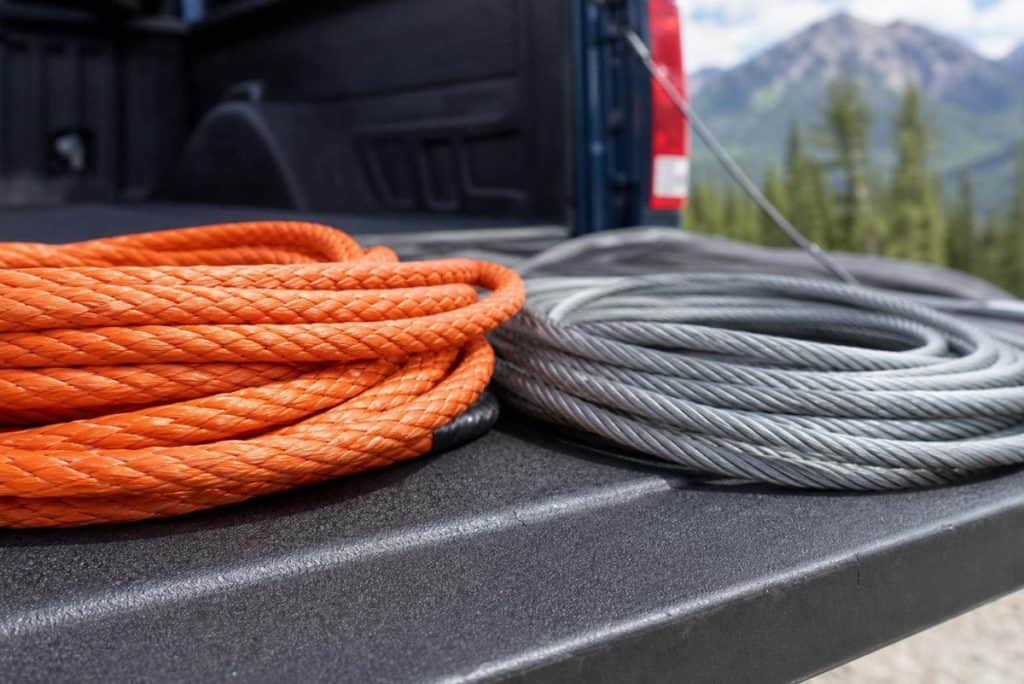
Synthetic rope and steel cable both pull a rig off a boulder or out of a mud hole. What separates them is how they fail. Steel cable stores kinetic energy under tension — a break under full load sends the cable snapping back at head height. Synthetic rope drops to the ground. That difference is why most serious off-road recovery setups have moved to synthetic over the last decade. Here’s how each one performs and when each one is the right call.
What is synthetic winch rope?
Synthetic winch rope is braided from UHMWPE fibers — Ultra-High Molecular Weight Polyethylene — most commonly Dyneema SK75 or SK78. The material is lighter than water, floats, and carries a higher tensile strength-to-weight ratio than steel. A 3/8-inch synthetic line rated at 17,500 lbs breaking strength weighs roughly 1 lb per 50 feet. The equivalent-diameter steel cable weighs 4–5 lbs per 50 feet.
The key safety property: synthetic rope stores almost no kinetic energy under tension. When it breaks — and any winch rope can break — it falls. It doesn’t snap back.
Warn Spydura (Warn’s branded synthetic line), AmSteel-Blue from Samson, and Dyneema SK78 bulk rope are the three most common options in the off-road market. All share the same UHMWPE core. Differences in braid tightness and outer coating affect abrasion resistance and how the line handles on the drum.
The limitation is abrasion. UHMWPE braids are vulnerable to cutting damage when the rope drags across sharp rock edges or the winch drum under high load. A synthetic line that runs repeatedly against raw basalt will develop surface fuzz and eventually core damage that isn’t visible until the rope is twisted open and inspected. Replace any line that shows core exposure.
What is steel winch cable?
Steel winch cable is a stranded wire rope, typically 7×19 construction — 7 strands of 19 wires each — in 3/8-inch diameter for most 8,000–12,000 lb rated winches. It’s been the default for decades, and it’s still the right call in specific environments.
Steel cable handles abrasion better than synthetic in rocky terrain. It doesn’t degrade from UV exposure. It doesn’t develop surface damage that requires regular inspection to catch. When the line runs through rocky gullies or against basalt edges repeatedly, steel takes it better.
The failure mode is the problem. Steel cable under tension stores elastic energy. At high loads — near the working load limit — a break under full tension releases that energy as a whip effect. The cable snaps back at the load, the operator, or whatever is in the path. This is how winch cable injuries happen. Draping a recovery kit weight bag over the cable mid-span during a pull reduces snap-back energy but doesn’t eliminate the risk.
Steel also develops kinks that weaken the cable over time. Frayed strands — called meat hooks — form from normal use and will cut hands during respooling or when handling the hook end. Gloves are non-optional with steel.
How do synthetic and steel winch cables compare?
| Attribute | Synthetic Rope | Steel Cable |
| Weight (3/8″ × 50 ft) | ~1 lb | ~4–5 lbs |
| Failure behavior | Drops to ground | Snap-back — releases stored kinetic energy |
| Abrasion resistance | Lower — vulnerable to rock edges and drum wear | Higher — handles rocky terrain better |
| Fairlead required | Hawse fairlead (aluminum) | 4-roller fairlead |
| UV/environment | Degrades with prolonged UV exposure; inspect regularly | No UV degradation; corrosion risk in salt environments |
| Hand safety | Safe to handle bare-handed | Frayed strands cut hands; gloves required |
| Price (100 ft, 3/8″) | $80–$180 (AmSteel-Blue, Spydura) | $30–$80 |
| Best for | General recovery, water crossings, most trail use | High-abrasion environments, dedicated rock crawlers |
When does steel cable fall short?
Steel cable falls short in two situations: water and operator safety.
In water crossings, steel sinks. If the rope settles on a river bottom during a crossing and you’re respooling under any load, you’re pulling silt and grit into the drum. Synthetic floats, stays manageable in the water column, and doesn’t trap debris the same way.
On operator safety, the snap-back failure mode is the more serious problem. At 10,000 lbs of tension, a steel cable break can send the line back fast enough to cause severe injury or death. The weight bag over the cable is the standard mitigation — but it requires the operator to remember to deploy it on every pull, every time. Synthetic rope eliminates the failure mode entirely, not just the severity.
Which should you run?
For most 4×4 rigs running a mix of trail recovery, mud, and water crossings, synthetic rope is the right answer. The safety advantage isn’t incremental — it eliminates a failure class that steel cable can’t fully solve. Warn Spydura 3/8-inch 100-foot and AmSteel-Blue bulk line are both well-proven in the market. Either one covers the Warn and Smittybilt 8,000–12,000 lb winch range.
The case for steel is specific: a dedicated rock crawling rig on basalt-heavy trails where rope-to-rock contact is frequent and the operator runs the weight bag without fail. Steel’s abrasion resistance pays off in that context. It’s not the general case.
I’ve run both. Switched the JKU to synthetic three years ago and haven’t looked back. The rope is lighter to handle, easier to unspool in a recovery, and I can reach the hook without gloves.
Does your fairlead matter when switching to synthetic rope?
Yes. Switching from steel cable to synthetic rope requires swapping the fairlead if your current setup runs a 4-roller fairlead. Roller fairleads are designed for steel — the grooved metal rollers can cut into synthetic rope under load. A hawse fairlead with a smooth aluminum opening is required for synthetic.
Hawse fairleads for a standard Warn or Smittybilt bumper opening run $30–$80 depending on material and finish. Factor 55 makes a well-regarded aluminum hawse in the $70 range. This is the only hardware change required for a steel-to-synthetic conversion on most winch setups — the line terminates at a standard hook or shackle on both configurations.
If your winch is mounted in a tube bumper with a roller fairlead bolted to the tube, confirm the bolt spacing matches a hawse fairlead. Most universal hawse fairleads cover standard 4.375-inch or 10-inch tube center spacing, but verify before ordering.
Frequently Asked Questions
Is synthetic winch rope stronger than steel cable?
At the same diameter, high-quality synthetic rope has a higher breaking strength than equivalent-diameter steel cable. A 3/8-inch Dyneema SK78 line carries a breaking strength around 17,500–18,000 lbs. Standard 3/8-inch 7×19 steel cable typically rates at 14,400 lbs breaking strength. The synthetic line is also significantly lighter at the same rating.
How long does synthetic winch rope last?
Synthetic rope lifespan depends on UV exposure, abrasion, and storage conditions. In regular off-road use, a well-maintained synthetic line can last 3–5 years. Replace it on any sign of core exposure from abrasion damage, significant surface fading, or after a high-load shock event such as a snatch recovery. Store out of direct sunlight when not in use.
Can you use synthetic rope on a standard steel drum winch?
Yes. Synthetic rope spools onto a standard steel winch drum without modification. The only hardware change required for a steel-to-synthetic swap is the fairlead — replace the roller fairlead with a hawse fairlead before running synthetic. The line terminates at the hook end with a standard hook or shackle that’s compatible with both rope types.
Shop Winch Lines and Recovery Rope
Winch line fitment is by winch rated capacity and drum capacity, not by vehicle. Confirm your winch’s working load limit and drum size before ordering — a line rated below your winch’s capacity is a mismatch in the wrong direction: winch lines and recovery rope.