
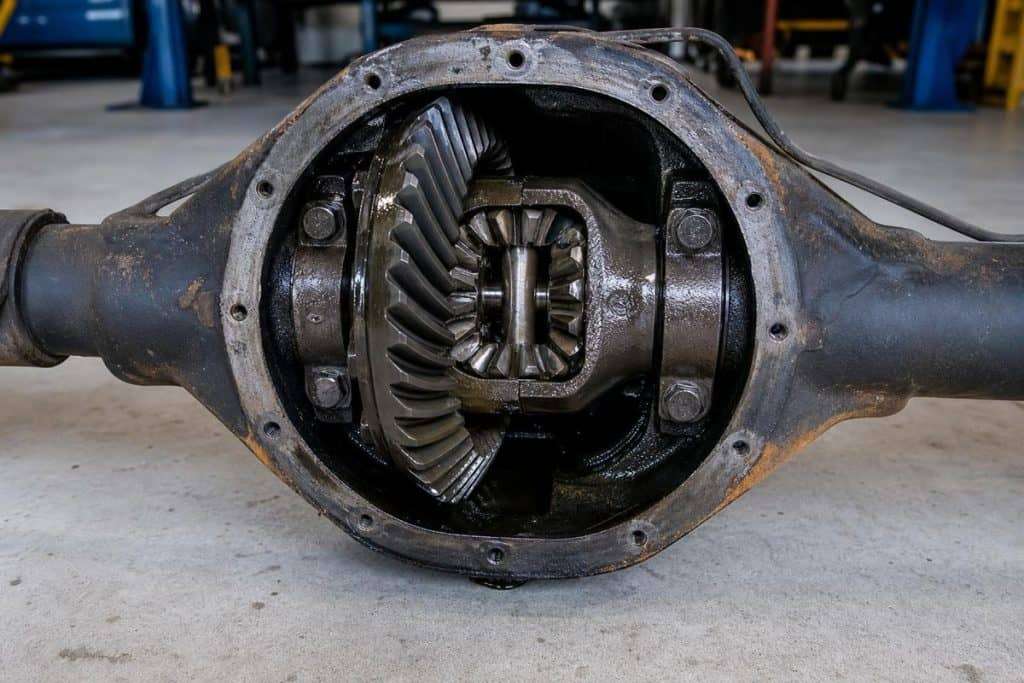
The two terms get used interchangeably, but they solve different problems at different points in the drivetrain. The difference matters most at the exact moment you need traction: one wheel lifted, one wheel buried, and the diff deciding where the power goes. Here’s how each mechanism works and when each one is the right call.
What is a locking differential?
A locking differential mechanically couples both axle output shafts together, forcing both wheels on the same axle to rotate at exactly the same speed. When a locker is engaged, torque is delivered equally to both wheels regardless of how much traction either one has. If one wheel is completely off the ground, the grounded wheel still receives full torque.
Two main types are common in the aftermarket:
Selectable lockers (ARB Air Locker is the most widely used example) function as a normal open differential until the driver engages them via air pressure or an electric actuator. On pavement the diff behaves normally. On the trail the driver locks it when conditions demand and unlocks it before returning to pavement. This gives you full off-road traction with no penalty to street handling.
Automatic lockers (the Detroit Locker is the classic) lock under drive torque and free up during coasting. The result is strong, predictable traction on trail climbs, but a characteristic clunk and push through tight pavement turns as the mechanism ratchets between states. Works well on a dedicated trail rig; noticeable on a daily driver.
What is a limited-slip differential?
A limited-slip differential (LSD) allows the two wheels on the same axle to rotate at different speeds, which is necessary for cornering, but limits how much speed difference it permits before transferring torque toward the wheel with more traction.
Most LSDs use one of three mechanisms:
Clutch-pack LSDs (factory Positraction, Eaton Posi, Traction-Lok) use friction plates that resist relative rotation between the two output shafts. When one wheel starts spinning faster than the other, the clutch pack engages and transfers torque toward the slower wheel. Effective for everyday traction improvement, but clutch packs wear over time and require periodic fluid service with a friction modifier additive.
Gear-type LSDs (Torsen, Eaton TrueTrac, Quaife) use helical or worm gears to sense torque difference between the two shafts and redistribute it without friction surfaces. More durable, completely transparent on the street, no maintenance beyond normal gear oil changes. The Torsen is fitted from the factory in the Jeep Wrangler Rubicon rear axle and appears in various performance vehicles.
Viscous LSDs use silicone fluid that resists shear to couple the output shafts in proportion to speed difference. More common in transfer cases than as standalone axle differentials.
How do locking differentials and limited-slip differentials compare?
| Attribute | Locking Differential | Limited-Slip Differential |
| Mechanism | Mechanically locks both output shafts to spin at the same speed | Limits speed difference; transfers torque toward the wheel with more traction |
| Trail performance (wheel lift or deep mud) | Full torque to both wheels regardless of traction imbalance | Transfer is limited by bias ratio; extreme imbalance can overwhelm it |
| Street behavior | Selectable: normal when unlocked. Automatic: clunky in tight turns | Smooth and transparent, no handling penalty |
| Maintenance | Selectable lockers: check seals and compressor periodically. Auto lockers: gear oil | Clutch-pack LSDs: friction-modifier fluid. Gear-type LSDs: standard gear oil |
| Best for | Rock crawling, deep mud, frequent wheel lift, serious off-road | Mixed-use daily drivers, snow, light-to-moderate trail, performance street |
When does a limited-slip differential fall short?
A limited-slip differential falls short when the traction difference between the two wheels exceeds its bias ratio limit. This happens most predictably when one wheel lifts completely off the ground, which comes up on uneven rocky terrain, off-camber slopes, or any obstacle that unloads a corner of the suspension.
When one wheel lifts, it offers zero resistance to spinning. Clutch-pack and gear-type LSDs transfer torque in proportion to resistance between the two shafts. If one shaft has zero resistance, most LSDs can’t generate enough bias to keep the planted wheel pulling. The lifted wheel spins freely, the planted wheel gets nothing, and the rig stops moving. This is where a locker’s forced mechanical coupling pays off: both shafts rotate together regardless of resistance, so the grounded wheel keeps pulling even when the other is airborne.
On light trails, wet roads, or packed snow, an LSD handles it comfortably. The more extreme the traction imbalance, the more clearly a locker outperforms.
Which should you run?
For a rig that splits time between the street and moderate trails, a quality gear-type LSD is the practical answer. The Eaton TrueTrac fits Dana 44 and Dana 60 rear axles, delivers real traction improvement, and behaves identically to an open diff on the street. No clutch wear, no friction modifier, no driving adjustment required.
For a rig that runs technical terrain regularly, rock crawling, or anything with frequent wheel lift, a selectable locker in the rear (at minimum) is the right tool. A selectable unit lets you drive to the trailhead on an open diff and lock it down when the terrain demands it.
I’ve run both configurations across a few different builds. The selectable locker in the rear is the most versatile setup for anyone who actually trails regularly and still commutes.
Both diffs work inside the axle. They’re a different part of the drivetrain from locking hubs, which disconnect the front wheel from the axle shaft entirely. If you’re sorting out the front drivetrain, start with how locking hubs work.
Frequently Asked Questions
Is a locking differential better than a limited-slip for off-road?
For serious off-road use, including rock crawling, deep mud, and terrain with frequent wheel lift, a locking differential outperforms a limited-slip. A locker delivers equal torque to both wheels regardless of traction difference. An LSD can be overwhelmed when one wheel loses traction entirely, sending power to the spinning wheel instead of the planted one.
Can you use a locking differential on the street?
Selectable lockers function as a standard open differential when not engaged and are fully street-compatible. Automatic lockers lock under drive torque and cause mild understeer and tire scrub in tight pavement turns. Manageable on a trail-dedicated rig, but noticeable day to day.
What is the difference between a limited-slip and a posi?
Positraction is GM’s name for their clutch-pack limited-slip differential. They are the same category of mechanism. Ford calls theirs Traction-Lok; Chrysler uses Sure-Grip. All are clutch-pack LSDs that function the same way and require periodic friction-modifier fluid service to maintain performance.
Shop Differentials by Axle
Locker and LSD fitment is specific to axle designation and ring gear size. What fits a Dana 44 differs from what fits a Dana 60 or an 8.8 Ford rear. Confirm your axle designation, ring gear diameter, and spline count before ordering..